For builders
Your L1's decentralization
doesn't matter.
Until it does.
A centralized validator set is a silent liability.
One attack, one outage,
one legal order.
All the value of your chain is at risk.
The risks
What's really at stake
Centralized validator sets carry invisible risks.
Until a hack, an
outage, or a legal order...
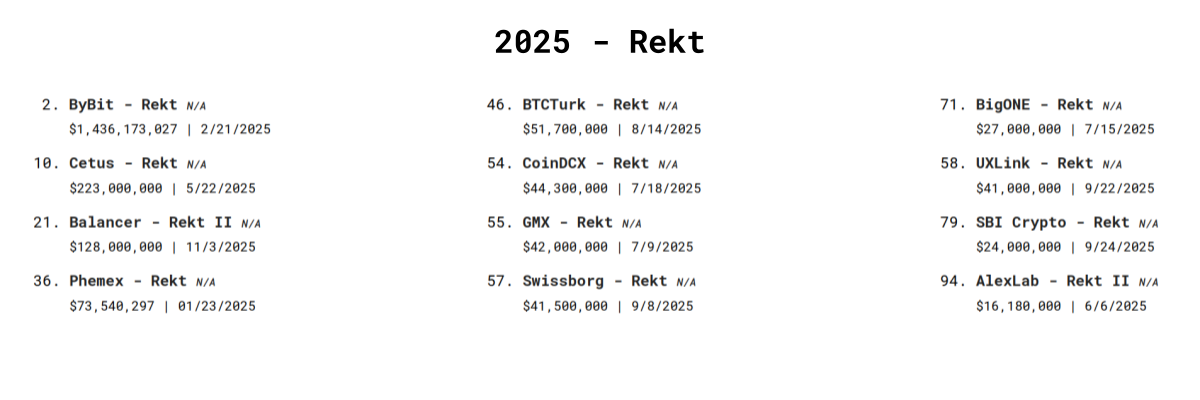
Hacks
ByBit lost $1.4B, Swissborg lost $41.5M…
… both due to an OpSec failure of their service providers. Any centralized setup WILL be breached. The only barrier is decentralization.

Bridged TVL
Hackers Drain All L1 TVL After Key Compromise
If a single entity controls more than 67% of your L1, accessing their keys allows to bridge out all the TVL of your chain.

Liveness
Operator Outage Causes L1 Halt for 6 Hours
More than 20% of your network going offline will cause your chain to halt, and temporarily prevent all transactions from being processed.
Take Action
The steps to decentralization
You don't need to go fully permissionless from day one.
Every step
forward reduces your exposure.
Audit
Start with our L1 Auditor tool. See what risks your L1 is exposed to and what weak points to prioritize.
Audit your L1SOON Coming soonPlan
Our team will help you design a progressive decentralization plan tailored to your constraints and objectives.
Talk to our team Implement
Permissionless
Leverage the Suzaku protocol to implement Proof of Stake.
TRUSTED BY


Implement
Permissioned
Leverage our team's operator network to distribute your chain's validator set.
Audit
Audit your L1SOON Coming soonStart with our L1 Auditor tool. See what risks your L1 is exposed to and what weak points to prioritize.
Plan
Talk to our teamOur team will help you design a progressive decentralization plan tailored to your constraints and objectives.
Implement Permissionless
Leverage the Suzaku protocol to implement Proof of Stake.
TRUSTED BY
Implement Permissioned
Leverage our team's operator network to distribute your chain's validator set.
The protocol
Decentralization Hub for L1s
The Suzaku protocol connects L1 teams with stakers and operators.
L1s move from PoA to PoS at their own pace.
Protocol TVL
$730,737
L1 Decentralization Phases
The L1 team controls the entire validator set
The BalancerValidatorManager splits control between PoA and PoS
Raise the PoS share progressively as the network matures
Set PoA weight to zero. 100% PoS.
Protocol participants
Set the L1's staking requirements. Deploy and curate the L1 LST. Our team handles the technical setup and ongoing support.
Stake L1 tokens, receive an LST usable across DeFi. Earn L1 staking rewards and other incentives.
Opt in to secure L1s, receive stake delegation to spin up validators and earn rewards based on uptime.
Set the L1's staking requirements. Deploy and curate the L1 LST. Our team handles the technical setup and ongoing support.
Stake L1 tokens, receive an LST usable across DeFi. Earn L1 staking rewards and other incentives.
Opt in to secure L1s, receive stake delegation to spin up validators and earn rewards based on uptime.
Audited by


About us
4 years of L1 blockchains expertise
We've been building tooling for L1 blockchains since 2021.
We know what breaks. We build to prevent it.
Running validators across multiple networks taught us the struggles of decentralization. We know where to focus our efforts to make it work.
ACP-99, written with Ava Labs, is the Avalanche standard for L1 validator set management. Our BalancerValidatorManager is built directly on this foundation.
We built Ash, an open-source toolkit for L1 operations, and are maintaining Ash Wallet, the multisig infrastructure for Avalanche L1s.
Partners & backers







Start with a free audit.
Know exactly where your L1 stands.
The L1 Auditor shows your decentralization stage in seconds. Free, no signup required.